


You explore the bible every day. You seek wisdom and guidance through reading the bible. You build a daily connection to god's word that inspires growth. You discover new insights with Bible maps that bring stories to life. You find peace and understanding as you read the bible.
-
📖 You strengthen your faith by connecting with the bible in fresh ways.
Key Takeaways
- Use Bible maps to visualize locations and events, enhancing your understanding of scripture.
- Incorporate timelines to see the chronological order of biblical events, making narratives clearer.
- Explore genealogies to uncover connections between characters and understand the fulfillment of prophecies.
- Combine maps, timelines, and genealogies for a comprehensive view of biblical history and context.
- Utilize tools like the ROSE BOOK to enrich your study experience and deepen your connection to the Bible.
Bible Maps for Study and Context
Bible maps help you unlock deeper meaning and context in scriptures. When you use maps, you see the geographical settings of biblical events. This makes the stories in the bible come alive. You can picture where Abraham traveled, where Moses led the Israelites, and where Paul spread the gospel. These visual tools help you connect events and places, making your study of the bible more engaging and memorable.
Choosing the Right Bible Maps
You want to choose bible maps that give you a clear picture of the biblical world. Look for atlases with quality pictures and topographical information. Make sure the maps cover many stories from the scriptures. Preview the maps before you buy to check their quality and accuracy. The ROSE BOOK OF BIBLE CHARTS, MAPS, AND TIME LINES (see more) stands out because it offers impressive visual charts and a variety of theological perspectives. You find maps that link geography with narrative, helping you understand the context of passages. The atlas includes over 120 full-color maps and detailed explanations of biblical geography, making it a valuable resource for your study.
Tip: Choose maps that show both ancient and modern locations. This helps you relate biblical events to places you know today.
- Bible maps recreate the ancient context of scripture.
- They provide clarity about locations in the bible.
- Maps remind you that biblical events happened in real places.
Integrating Maps into Daily Study
You can use maps every day as you read the bible. When you come across a place name in your passages, pause and find it on a map. This practice helps you see how far people traveled and why certain locations mattered. For example, when you read about Paul's journeys, tracing his route on a map helps you understand the challenges he faced. Maps also make it easier to follow complex narratives, like the Exodus or the division of Israel's kingdoms.
- Maps simplify reading by giving you a visual reference.
- They help you connect events across different scriptures.
- You see how geography shaped the lives of biblical characters.
Note: Visualizing journeys engages your brain in new ways. You remember stories better when you see them mapped out.
Visualizing Journeys and Locations
Maps let you visualize key journeys and locations in the bible. You can trace the Exodus route, see the spread of the Roman Empire, or explore the city of Jerusalem in Jesus' time. The table below highlights some important journeys and locations you can study with bible maps:
|
Journey/Location |
Description |
Historical Importance |
|---|---|---|
|
The Exodus and the Journey to the Promised Land |
The Israelites' journey from Egypt to Canaan, including Mount Sinai. |
Foundational for understanding the narrative of Exodus. |
|
The Roman Empire at the Time of Christ |
Territories controlled by Rome, central to Jesus’ ministry. |
Key for understanding the political context of Jesus' life. |
|
Ancient Israel and Its Kingdoms |
Geographic and political layout under David and Solomon. |
Shows the significance of Jerusalem and the divided kingdoms. |
|
The Holy Land in the Time of Jesus |
Region where Jesus ministered, with significant sites marked. |
Important for understanding cultural dynamics in Jesus' time. |
|
The Apostolic Journeys of Paul |
Missionary travels of Paul throughout the Roman Empire. |
Essential for understanding the spread of Christianity. |
|
The Exodus Route and the Promised Land |
Route taken by Moses and the Israelites, with key locations. |
Connects you to the biblical narrative of the Exodus. |
|
The City of Jerusalem in the Time of Jesus |
Detailed look at Jerusalem during the 1st century, showing key structures. |
Important for understanding religious and social divisions. |
When you visualize these journeys, you engage both the visual and language parts of your brain. This helps you remember and understand the passages better. Publishers include maps of biblical journeys to help you follow complex stories, like Paul's missionary travels.
📍 Remember: Bible maps help you see the world of the scriptures. They make the context of passages clearer and more meaningful.
FAQ
Q: How do bible maps help with context?
A: Bible maps show you the geographical settings of biblical events. This helps you understand the original message of the scriptures and see how geography influenced the stories.
Q: What are simple ways to use maps in study?
A: You can look up places mentioned in your daily passages, trace journeys, and compare ancient locations to modern ones. This makes your study more interactive and memorable.
Timelines for Bible Chronology
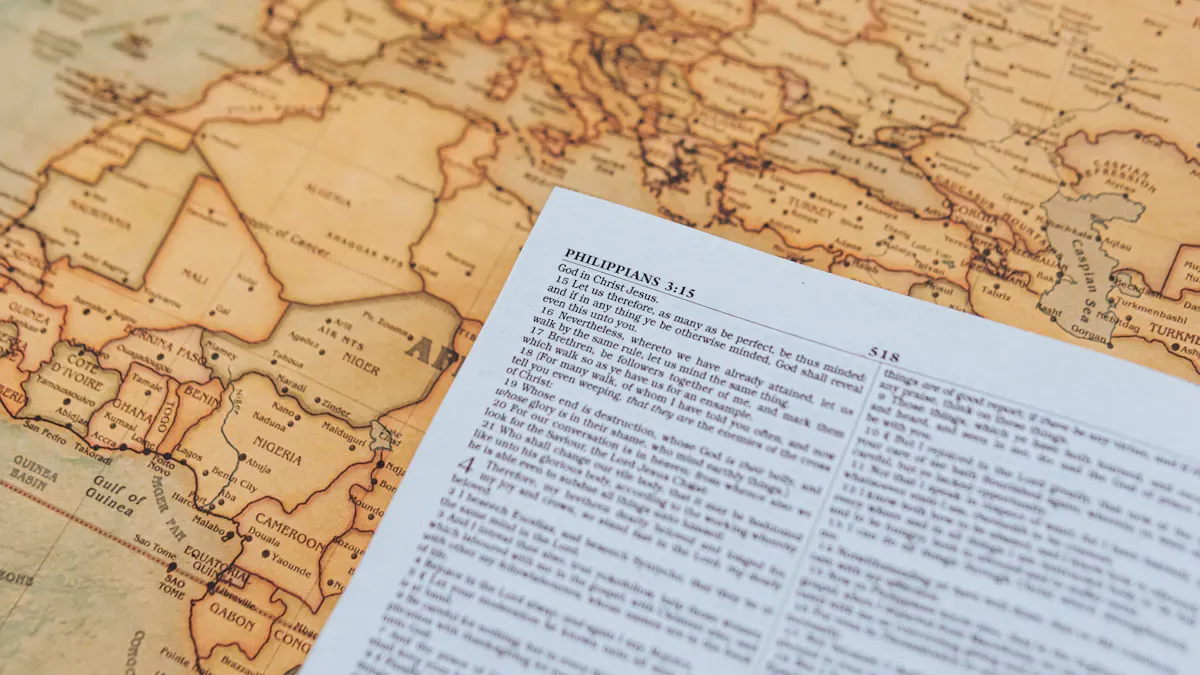
Timelines give you a panoramic view of the bible’s chronological order. You see how biblical events fit together, making the narrative clearer and more meaningful. When you use timelines, you organize stories from Creation to the end times. This approach helps you understand the historical context and see the flow of the narrative. You notice how key bible characters fit into the larger narrative, which supports deeper understanding.
- Timelines help you grasp the interconnectedness of bible stories.
- You see the relationships between people and events before you read specific sections.
- This method enhances your understanding of chronological events and historical context.
Clarifying Events with Timelines
You use timelines to clarify the chronological order of biblical events. They show you how one event leads to another, making the narrative easier to follow. For example, when you study the life of Abraham, a timeline reveals connections between his story and other events. Visual representations, like charts, help you see relationships and the chronological order, which leads to deeper understanding of the narrative.
- Timelines arrange people, events, ages, and eras in relation to one another.
- They illustrate cause and effect, showing how one event influences the next.
- You recognize patterns across centuries, which helps you understand major shifts in the narrative.
Using Timelines with Scripture
You can use timelines alongside scripture passages during your study. Try drawing stick figures or using color coding to represent characters and events. This makes your study more engaging and helps you remember the chronological order. Ask questions as you go, using the timeline to check your understanding. Adapt your approach for different ages—simple drawings for younger students, more details for older ones.
- Visualize while you study to enhance engagement.
- Ask questions to assess your understanding of the chronological order.
- Adapt your timeline drawings to fit your needs.
Connecting Events Across Books
Timelines help you connect events that happen in different books of the bible. You see the narrative spine, cause and effect, and the length of events. This gives you a deeper understanding of the historical context and the chronological order of the narrative.
|
Aspect |
Explanation |
|---|---|
|
Narrative Spine |
Timelines arrange people, events, ages, and eras in relation to one another. |
|
Cause and Effect |
They illustrate the connections between events, showing how one event leads to another. |
|
Length of Events |
Timelines help you understand the duration of events across biblical history. |
|
Patterns Across Centuries |
They allow recognition of historical patterns, aiding in the understanding of major shifts. |
📅 Tip: Use timelines to see the big picture of the bible. This helps you gain deeper understanding and context for every narrative.
FAQ
Q: Why use timelines in Bible study?
A: Timelines help you see the chronological order of biblical events, making the narrative easier to follow and understand.
Q: How do timelines help with understanding chronology?
A: Timelines show you how events fit together, reveal cause and effect, and provide historical context for deeper understanding.
Genealogies and Bible Connections
Importance of Genealogies
You discover that genealogies play a vital role in your bible study. These records reveal the lineage of key characters, especially those connected to Jesus Christ. Genealogies help you see how prophecies unfold and provide context for biblical narratives. When you trace family lines, you understand the historical narrative and see how different characters relate to each other. The genealogy includes figures like Moses from the tribe of Levi and Judah, whose lineage connects to Joseph and Mary. You also notice the importance of mothers in these lineages, which highlights the inclusive nature of the bible.
🧬 Tip: Genealogies give you a roadmap for understanding relationships between characters and events in biblical narratives.
Tracing Family Lines
You use genealogy charts to trace family lines throughout the bible. These charts clarify the lineage of Jesus and show the significance of various characters. You gain a structured overview that simplifies the relationships within biblical narratives. The ROSE BOOK OF BIBLE CHARTS, MAPS, AND TIME LINES offers detailed genealogy charts that make connections clearer. You see the lineage from Adam to Jesus and identify gaps or selective records. This process helps you understand the flow of biblical narratives and the roles of influential women and men.
- Genealogy charts enhance your bible study by making connections visible.
- You identify the lineage of characters and see how their stories fit into the larger narrative.
- These charts serve as practical tools for both casual readers and serious students.
Insights from Genealogy Charts
You uncover new insights when you use genealogy charts in your bible study. These charts highlight influential women in genealogies and offer a more inclusive perspective on biblical history. You recognize the selective nature of biblical genealogies and identify gaps that prompt further study. Genealogy charts help you engage with the bible and make your study more interactive.
|
Benefit |
Description |
|---|---|
|
Clarifies Relationships |
You see how characters connect across biblical narratives. |
|
Highlights Influential Women |
You recognize the roles of mothers and women in genealogies. |
|
Simplifies Study |
You gain a structured overview that makes understanding easier. |
|
Reveals Prophecy Fulfillment |
You see how genealogies support the fulfillment of prophecies. |
📚 Note: The ROSE BOOK genealogy charts (view here) help you visualize family lines and deepen your understanding of biblical narratives.
FAQ
Q: What can genealogies teach in bible study?
A: Genealogies reveal relationships between characters, show prophecy fulfillment, and provide context for biblical narratives.
Q: How do I use genealogy charts?
A: You can trace family lines, clarify connections, and gain a structured overview of characters in the bible.
Bible Study Tools and Resources
Closerout’s Bible Book Collection
You find a wide range of bible study tools at Closerout. The Bible category offers resources that support your reading the bible and deepen your understanding. You explore atlases, study bible guides, and maps that help you visualize scripture. Closerout’s Bible collection (browse here) includes tools for every learning style. You also discover the all-books page (see all books), which gives you access to even more resources for your study. 📚
🛒 You enjoy free worldwide shipping on orders over $39.99. This makes it easy to build your library of bible study tools and resources.
Choosing Study Tools
You select bible study tools based on your learning preferences. Some tools focus on interpretation, while others help you apply scripture to daily life. You decide if you want guidance from experts or prefer to explore meanings independently. The table below shows criteria for choosing the right tools for your study bible experience:
|
Criteria |
Description |
|---|---|
|
Bible Translation |
Choose a translation that resonates with you for better understanding. |
|
Study Approach |
Decide if you prefer interpretation or application of scripture. |
|
Authority vs. Autonomy |
Select tools that offer expert guidance or allow independent exploration. |
You match tools to your needs, making your bible study more effective and engaging.
Free Shipping Benefits 🚚
You benefit from free shipping when your order exceeds $39.99. This allows you to access bible study tools and resources without worrying about extra costs. You build your study bible collection and enjoy reading the bible with new tools that enhance your understanding.
💡 Tip: Take advantage of free shipping to expand your bible study tools and resources for group or personal study.
FAQ
Q: What bible study tools are available?
A: You find atlases, maps, study bible guides, timelines, and genealogy charts in Closerout’s Bible collection.
Q: How does free shipping work?
A: You receive free worldwide shipping on orders over $39.99, making it easier to access bible study tools and resources.
Verse Mapping for Deeper Context
What Is Verse Mapping?
Verse mapping gives you a structured way to explore the bible. You break down a verse to understand its context, translation, and meaning. This method helps you see how each word and phrase fits into the bigger picture of God’s Word. You use verse mapping to dig deeper into scripture and connect with the message on a personal level.
|
Definition of Verse Mapping |
Description |
|---|---|
|
Verse Mapping |
A Bible study method that examines the context, cross-references, translations, and word meaning of a particular verse in God’s Word. |
📝 Tip: Verse mapping helps you move beyond just reading the bible. You discover the richness of each verse and gain new insights.
Applying Verse Mapping in Study
You can start bible mapping with a few simple steps. This process makes your study more interactive and meaningful.
- Write out the verse before and after your chosen verse to understand the surrounding context.
- Gather at least one other translation of your chosen verse to compare meanings.
- Identify keywords and repeated phrases to uncover deeper significance.
You learn more about God’s message by researching the historical context, translation, and theological framework of each verse. This approach supports your understanding and helps you apply scripture to your life.
📖 Verse mapping turns reading the bible into a journey of discovery.
Tools for Verse Mapping
You find many tools that make bible mapping easier and more effective. The ROSE BOOK OF BIBLE CHARTS, MAPS, AND TIME LINES (see details) serves as a valuable bible mapping book. It provides maps, timelines, and charts that support your study and understanding. You can also use journals, guided studies, and special bibles designed for verse mapping.
|
Tool Name |
Description |
|---|---|
|
Verse Mapping Journal |
A journal with space for notes and personal entries. |
|
Verse Mapping Bible Studies |
Studies with prompts and historical context for individual or group use. |
|
Verse Mapping Bible |
A bible with dedicated pages for mapping, including guided and blank maps for your own entries. |
📚 Note: The right tools help you organize your thoughts and deepen your understanding of the bible.
FAQ
Q: What is verse mapping?
A: Verse mapping is a method that helps you break down a verse to study its context, translation, and meaning.
Q: How does verse mapping help with context?
A: Verse mapping lets you see how a verse fits into the larger story of the bible, making your understanding clearer.
Combining Study Tools for Impact
Cross-Referencing Maps, Timelines, Genealogies
You gain the most insight when you use bible maps, timelines, and genealogies together. Each tool gives you a different view of the same story. When you cross-reference these resources, you see how people, places, and events connect. This approach helps you move beyond just reading the bible. You start to see the bigger picture and understand the flow of biblical history.
Rouse noted, "When people can see a story, it takes on new life. It becomes understandable." Visual representations of genealogies, maps, and timelines enhance your comprehension and engagement during study sessions.
You can use a map to locate where an event happened, a timeline to see when it happened, and a genealogy chart to learn who was involved. This method supports your understanding and makes your study more interactive.
Sample Study Session
You can combine these tools in a single bible study session. The table below shows how different resources work together to give you a complete view:
|
Resource Type |
Description |
|---|---|
|
Bible Infographic Suite |
Combines visual timelines, geography maps, and story panels for a holistic view of biblical themes. |
|
Cross-referencing Panels |
Links timeline events to map paths and story panels, deepening your understanding of narratives. |
|
Genealogical Infographics |
Maps lineages across generations, highlighting key interruptions and prophetic foreshadowing. |
|
Visual Timelines |
Arranges people, events, ages, and eras, making the flow of biblical history clear and showing cause and effect. |
You might start by reading the bible passage, then look at a map to see the location. Next, use a timeline to place the event in history. Finally, check a genealogy chart to see the family connections.
Group and Personal Study Tips
You can use these tools in both group and personal study. In a group, assign each person a tool to research and share their findings. For personal study, create a notebook where you draw maps, timelines, and family trees. This hands-on approach helps you remember details and strengthens your understanding.
💡 Tip: Try using colored pencils or sticky notes to mark important places, people, and events. This makes your study more engaging and fun.
FAQ
Q: How do I combine bible maps, timelines, and genealogies?
A: Use maps to locate events, timelines to see when they happened, and genealogies to understand who was involved. This gives you a fuller understanding of the bible.
Q: What are group study ideas for using these tools?
A: Assign each group member a different tool, then share your findings. You can also create a large wall chart together to visualize connections.
You gain a deeper understanding of the bible when you use visual tools like maps, timelines, and genealogies. These resources help you see the flow of history, connect key people, and enrich your study. The table below highlights how these tools support your learning:
|
Tool |
Benefit |
|---|---|
|
Maps |
Improve awareness of biblical locations |
|
Timelines |
Clarify chronological order of events |
|
Genealogies |
Reveal connections between important figures |
“AI will soon enhance bible study with immersive and interactive experiences.”
FAQ
How do I start a bible study with maps and timelines?
You begin by selecting a passage. Use a map to locate places mentioned. Refer to a timeline to see when events happened. This approach helps you understand the context and makes your study more interactive. 🗺️
What tools help me organize my bible study?
You can use journals, charts, and visual aids. The ROSE BOOK provides maps, timelines, and genealogy charts. These tools help you track your progress and deepen your understanding. 📚
Can I use bible study tools for group sessions?
You can share maps, timelines, and genealogy charts with your group. Assign each person a tool to research. Discuss your findings together. This method encourages teamwork and makes your study engaging. 🤝
Why should I include genealogies in my bible study?
Genealogies show connections between people and events. You see how prophecies unfold and understand the lineage of key figures. This adds depth to your study and helps you grasp the bigger picture. 🧬
Where can I find resources for bible study?
You find resources at Closerout’s Bible collection. Explore atlases, guides, and visual tools. Free shipping is available for orders over $39.99, making it easy to build your study library. 🚚


